
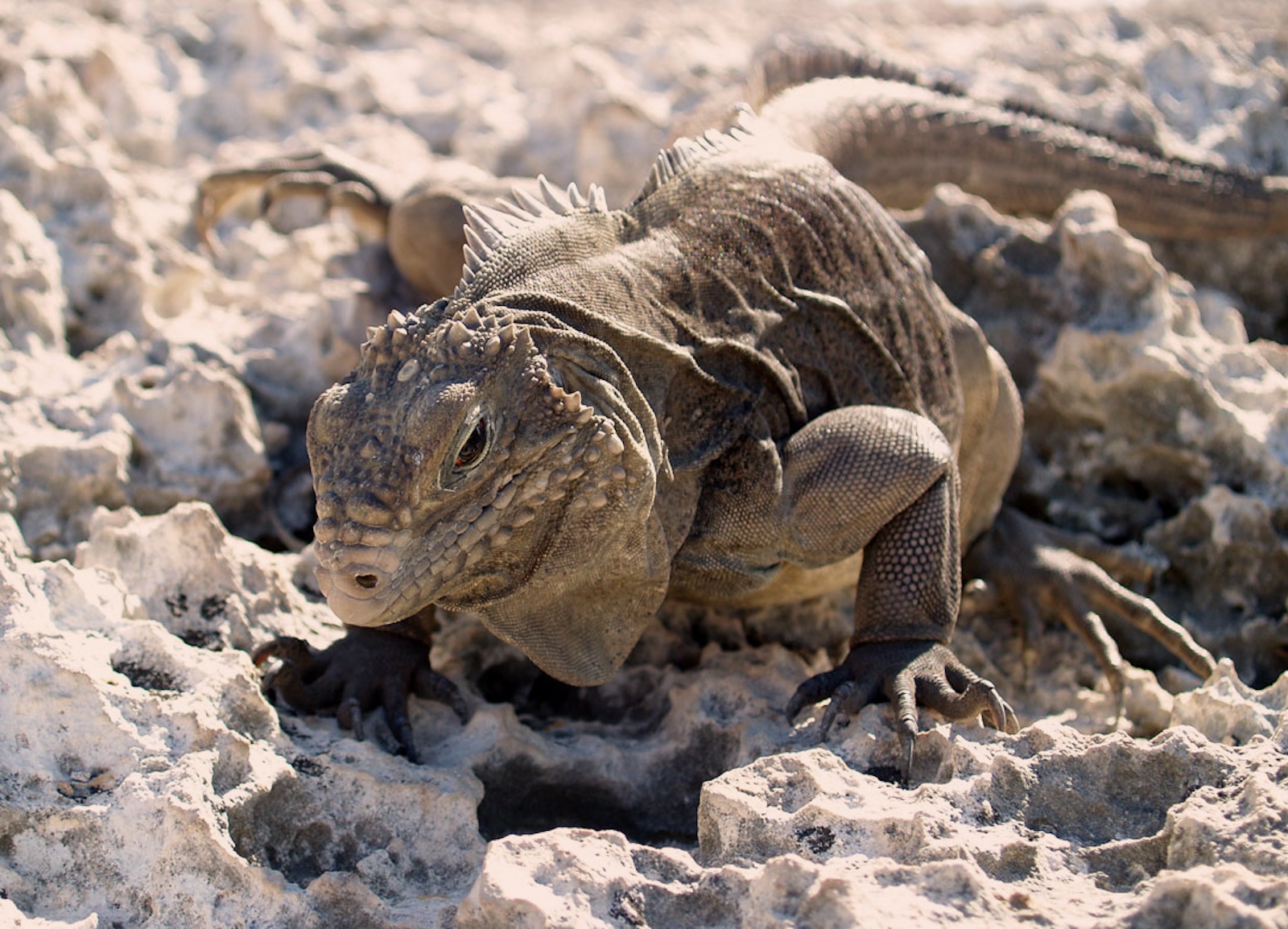
Blacktip Island ‘s new iguanaers have begun ‘flying’ the Caribbean island’s native rock iguanas at downed fruit for sport. (photo courtesy of Staselnik)
A group of Blacktip Island sport hunters have organized what they term the Blacktip Island Iguanary Club, aimed at using the small Caribbean island’s native iguanas to hunt fruit as a sport, group organizers said.
“It’s like falconry, but different,” Rusty Bollard said. “Iguanas are herbivores, so we’ve trained them to retrieve fruit folks might otherwise have overlooked or been unable to get to. The process is similar to falconry—the iguana perches on the iguanaer’s leather glove until released, then it scuttles, quick-like-the-bunny, after the indicated fruit.
“We use the big rock iguanas to go after downed fruit, mostly mangoes and sea grapes, and the smaller green iguanas to get out-of-reach stuff like papayas and sweet bananas,” Bollard said. “There’s a real adrenalin adrenaline rush when the iguana takes off. It’s damned addictive.”
Club members described the iguana training process.
“Bringing fruit back without eating it isn’t natural behavior for iguanas,” Christina Mojarra said. “We start early—right after hatching, if possible—using fruit-shaped lures on a string to get the iguanas used to bringing it back to the leather glove. We gradually give them more and more leeway, and by the time they’re about six months old the behavior’s ingrained.
“We got most of these techniques from Medieval falconry codices and the Blacktip Island settlers’ chronicles,” Mojarra said. “If falconry is the sport of kings, iguanary’s the sport of pirates. It was hugely popular among old-time buccaneers. Blackbeard himself was a keen iguanaer.”
The new sport is not without its opponents
“It’s cruel to catch these endangered creatures immediately after hatching,” Blacktip Island People for the Ethical Treatment of Animals president Harry Pickett said. “And it’s beyond cruel to make teach them unnatural behavior by denying them food. These aren’t sport hunters, they’re sadists and animal abusers.
“Under the island’s endangered species ordinances, this is illegal,” Pickett said. “But, evidently, money’s crossed the right palms. Rusty and them think this’ll draw visitors to the island, but it’ll have the opposite effect once tourists see what the score is.”
Club organizers disputed those claims.
“These captive iguanas are better fed, and healthier, than any wild iguana,” Bollard said. “These are like our children—they get daily care and regular medical attention. Truth be told, iguanary’s getting a lot of attention on nearby islands and shows every sign of growing in popularity.
“That’s our long-term goal,” Bollard said. “This is the sport of the future. We’re limited in fruit varieties here, but on other islands there’s kumquats, starfruit, and even durian. We’re already working out qualifying criteria for apprentice, general and master iguanary divisions. We’ve seen the future, and the future is iguanary.”



 The Blacktip Times