Tag Archives: Blacktip Island

Underwater Golf Comes To Blacktip Island

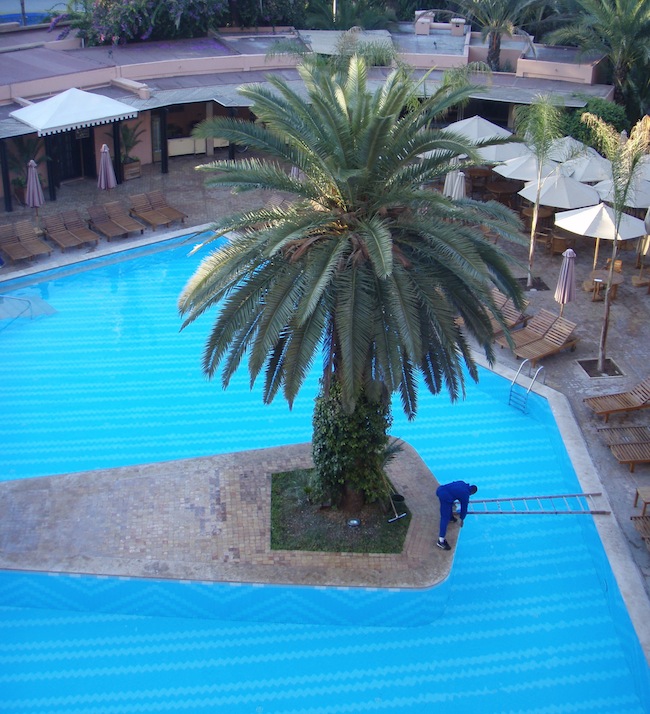
A groundskeeper prepares the first tee at Sandy Bottoms’ Beach Resort’s new underwater gold course for Friday’s grand opening.

A groundskeeper prepares the first tee at Sandy Bottoms’ Beach Resort’s new underwater golf course for Friday’s grand opening.

Blacktip Island golfers will tee off underwater Friday when Sandy Bottoms Beach Resort opens its 18-hole underwater golf course, allowing scuba divers to tour the island’s reefs while golfing.

“A lot of our guests felt left out,” resort owner Sandy Bottoms said. “Scuba golf reaches out to a broader demographic eager for underwater activities and topside attractions.

“It’s the first of its kind in the Caribbean,” Bottoms said “There was a place over in China tried it last year, but their caddies kept drowning.”

“It’s like regular golf, really,” course designer Rocky Shore said, “Except the course hazards are hungry barracuda, coral heads and jellyfish.”

“Another challenge is mantis shrimp claiming the holes,” Shore said. “We shoo them out, but they scuttle right back. Then one claw snap and BAM! your ball’s in a hundred pieces.”

Resort guests had mixed reactions to the new activity.

“I like to dive, and my wife likes to golf,” visitor Buddy Brunnez said. “Now we can dive and golf together. I’m not sure that’s a good thing. For either of us.”

Non-golfing divers complain the course is laid out across a dozen of the island’s most popular dive sites.

“They’re dropping folks into an incredibly fragile ecosystem to flail around with clubs,” Blacktip Haven resort owner Elena Havens said. “We’ve already seen scolfers blasting out of coral heads with pitching wedges and whacking balls at stingrays.

“And what of the habitat destroyed creating this atrocity?” Haven said.

Bottoms was quick to allay environmental concerns.

“We chose sandy areas for each hole,” Bottoms said. “There was no need to landscape. Well, not too much, anyway. And our course rule is you add a stroke to your score every time you damage coral.”

For island dive professionals, safety is a bigger concern.

“You can yell, ‘fore’ all you want down there, but no one’ll hear you,” said divemaster Marina DeLow. “I had two divers get plunked today. And playing 18 holes, they’re gonna have yahoos blowing their no-decompression limits left and right.”

“We put all these holes in 20 feet of water or less,” Bottoms said. “Getting bent shouldn’t be an issue. Unless you’re a bad golfer. Or get a hole with a mantis shrimp in it.”

Bottoms also plans to build a knee-deep miniature golf course for non-divers and children too young to be certified.

“There’ll be an underwater shopping mall, too,” Bottoms said. “It’ll be tasteful, though, really spruce up the reef.”

Leave a comment

Filed under Caribbean, Scuba Diving

Blufftop Observatory to Boost Blacktip Island Economy

The Blacktip Island Observatory will feature a 3.7-meter optical/IR telescope, as well as a baseline array for submillimeter astronomy.

The Blacktip Island Observatory will feature a 3.7-meter optical/IR telescope, as well as a baseline array for submillimeter astronomy.

Tiperon University-Blacktip officials confirmed Thursday the university has resurrected plans for an observatory on Blacktip Island’s southern bluff. The facility will be funded by space agencies from several Caribbean nations.

The project, long stymied by opposition from developers and environmentalists, gained new life when that opposition unexpectedly faded.

“I don’t know what good some giant telescope’s going to do anyone,” said Eagle Ray Cove resort owner Rich Skerritt, formerly the project’s most vocal opponent. “Another resort or two’s what Blacktip needs, but if the community’s dead set on this white elephant, I’ll go along with it for the common good.

“Plus, it’s nice to get under the skin of those pointy-head treehuggers.”

The observatory will be built on land formerly owned by the Skerritt family. Work on the facility, by Skerritt Construction, will begin next week.

The scientific community has coveted the Blacktip Island site for years.

“Blacktip’s sky quality is unique in the Caribbean,” TU-B astrophysicist chairperson Ursula Majors said. “With minimal development and the nearest island being 100 miles away, light pollution is non-existent. The only building at the south end is the Last Ballyhoo bar, and electricity’s out in that place more often than not.

“More significantly, the fumes from the island’s booby pond counteract the moist maritime air to produce some of the clearest skies in the Caribbean,” Majors said. “Usually you have to get above 12,000 feet in the desert to get air clarity like this.”

Current plans have the observatory conducting optical, infrared, and submillimeter astronomy, Majors said.

Many locals welcomed the news.

“It’ll be a shining star for our economy,” said island mayor Jack Cobia. “This shows the world Blacktip’s not just about drinking rum and gossiping about your friends. We’re contributing to the advancement of human knowledge now. And folks at the Ballyhoo’re eager for the uptick in business, too.”

Island environmentalists, however, still oppose the project.

“There’s rare and endangered species down there we’ve only just begun to study,” TU-B biodiversity professor Ernesto Mojarra said. “The Blacktip greasy palm is found only on the high bluff. And the redneck warblers have vital breeding grounds all around the Ballyhoo.”

Most residents, though are excited about the new facility.

“It’s brilliant there’ll be professional astronomers here,” divemaster Lee Helm said. “My girlfriend, she’s a Pisces with Virgo rising. Now I’ll be able to suss out exactly what makes her tick.

“I’ve an appointment to get my own star chart done, too, as soon as that radio telescope gets up and running.”

Leave a comment

Filed under Caribbean

Blacktip Island Hosts Pro-Am Bird Watching Championship

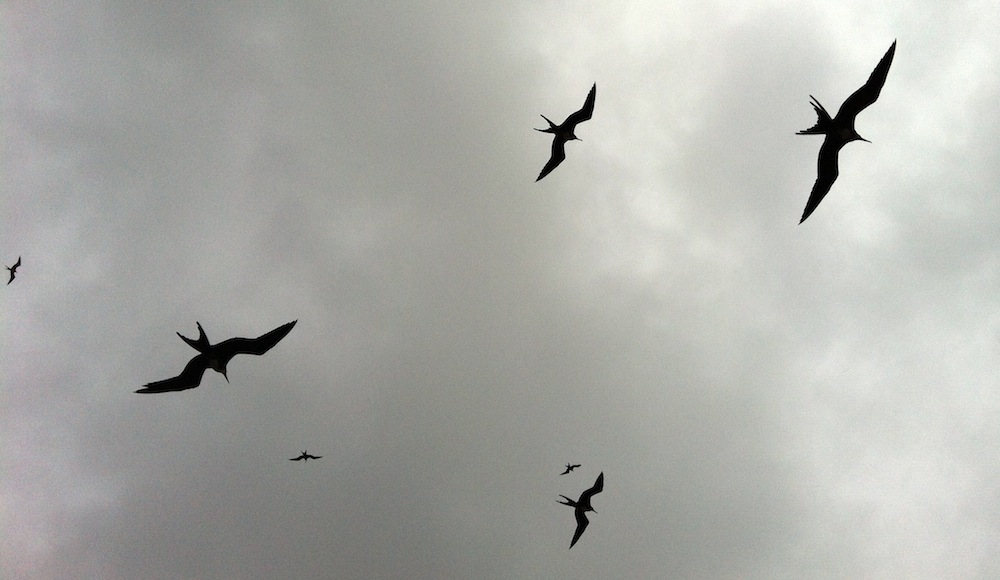
Professional birders from around the world are flocking to Blacktip Island for this week’s pro-am bird watching tournament.

Professional birders from around the world are flocking to Blacktip Island for this week’s pro-am bird watching tournament.

The Blacktip Island Pro-Am bird watching competition kicks off Saturday morning, with professional and amateur birders from around the world competing for the coveted Booby Prize. The week long event is one of the Birding Grand Slam’s five tournaments.

“We expect quite a robust competition this year,” Blacktip Island Audubon Society president Sula Beakins said. “Blacktip’s place as a waypoint on the flyways between North and South America make it a hot spot for resident and transient feathered friends alike.”

The tournament will pair international birding superstars such as Martin Grebe, Zenaida Dove and Elaenia Kestrel with local avian aficionados including Bob White, Noddy Bolin and Reg Gurnard.

The Audubon Society implemented several rule changes this year to avoid the altercations that detracted from past Pro-Ams.

“All sightings must be confirmed first hand by Society judges,” Beakins said. “There was so much sniping, and fisticuffs, last tournament when two competitors were caught photographing handmade bird likenesses. This year’s judges won’t be so gullible.

“We’ve also banned water drips for attracting birds,” Beakins added. “Competitors can grouse all they want, but those drips were sushi bars for the feral cats. We’ll not have a repeat of last year’s carnage.”

Scores are derived from algorithms factoring in total birds sighted, total species sighted and the rarity of species sighted by each team.

“That old coot Clete Horn was a distant third last year before he spotted that band-rumped storm petrel,” competitor Bob White said. “One bird gave him and Zenaida Dove the win.”

“The Blacktip ham hawk is the Holy Grail, of course,” local bird guru Reg Gurnard said. “They were hunted nearly to extinction decades ago. Island old timers just loved them with butter beans and greens.”

Local restaurants and bars are hungry for the economic uptick the tournament brings.

“These birdwatchers are crazy as loons,” Sand Spit bartender Cory Anders said, “But they’re big drinkers, they tip well and they don’t tear the place up too bad until post-tourney.”

International birding stars are eager for the tournament to begin.

“It’s lovely to see so many titmice this year,” said professional birder Jay Grackle. “And Caribbean tits. Boobies are a given on Blacktip, but these tits are an unexpected surprise.

“The absence of egrets is also nice, for me, anyway,” Grackle said. “I try to live my life with no egrets.”

Leave a comment

Filed under Caribbean

Blacktip Island Resort Beams Up Weighty Divers

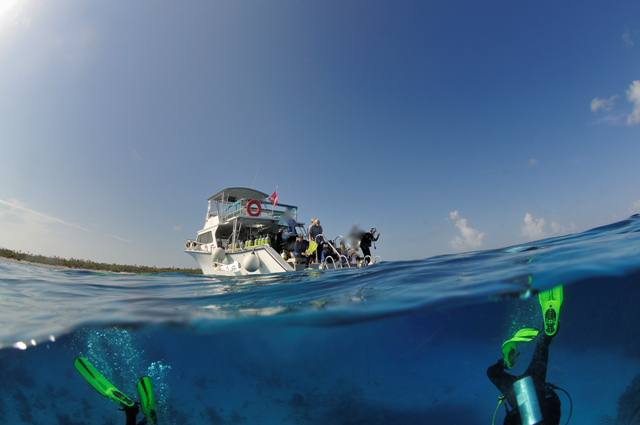
Scuba divers are lifted from the water and onto Eagle Ray Divers’ Barjack dive boat following Thursday’s afternoon dive. (photo courtesy Steve Dingledein)

Scuba divers are lifted from the water and onto an Eagle Ray Divers dive boat following Thursday’s afternoon dive. (photo courtesy Steve Dingledein)

In a move that has angered many Blacktip Island scuba diving guests, Eagle Ray Divers is using an experimental tractor beam to lift scuba divers wearing too much lead weight back onto the resort’s dive boats.

Divers claim the device’s use is aimed at weighty divers, not the divers’ weights.

“It was mortifying,” Eagle Ray Cove guest Bud Turbot said. “Thinner divers were allowed to climb back onboard on their own, but us fuller-sized folks, they made us be beamed aboard while everyone gawked. My wife’s still in tears. It’s size-ism, pure and simple.”

Eagle Ray Divers operations manager Ger Latner denied the claims.

“It’s not an indictment of our divers,” Latner said. “It’s about our insurance premiums and divemaster durability. These people cram their BCs with 18, 20 pounds of integrated weight. No way our staff can handle those things day in, day out on a rocking boat without doing themselves major damage.”

“We tried asking guests to take their weight pockets out,” said Eagle Ray Divers divemaster Gage Hoase. “A few do, but most refuse. One over-weighted BC at the wrong time can end a divemaster’s career.

“This gizmo’s a game changer,” Hoase said. “Not swapping over weight-integrated BCs means no mangled backs or blown elbows.”

Eagle Ray Cove resort management enlisted the aid of local scientists after a rash of dive staff injuries.

“Our attraction beam prototype was at the trial stage,” said Tiperon University-Blacktip magneto-gravitic engineering professor Stina Ray. “Hauling in divers provides the perfect beta test. And if it keeps people from getting hurt, that’s an added bonus.

“We installed the beam generators on Ger’s boats, and his staff records the raw mass, distance and erg data for us,” Ray said. “The dive leaders say it works on divers who exceed their profile times, too.”

Eagle Ray Cove’s dive guests remain outraged.

“That beam thingy snatches you up any which way,” diver Leah Shore said. “If you’re not perfectly upright in the water when it locks on, it’ll haul you aboard ass over appetite, with the whole boat laughing at you. And what happens if that thing gives out mid-lift? They don’t mention that in the briefings.”

Eagle Ray Divers’ Latner was unapologetic.

“Something had to be done,” Latner said. “These human anchors were breaking my divemasters faster than I could hire them. You don’t want to be beamed up? Learn proper buoyancy. And skipping the dessert buffet wouldn’t hurt, either.”

Leave a comment

Filed under Caribbean, Scuba Diving

Blacktip Island Resort Launches Lionfish Spa

A free-range Indo-Pacific lionfish readies for a day’s work at Blacktip Haven’s new Lionfish Beauty Spa. (photo courtesy of Paula Whitfield)

A free-range Indo-Pacific lionfish readies for a day’s work at Blacktip Haven’s new Lionfish Beauty Spa. (photo courtesy of Paula Whitfield)

Blacktip Haven resort will open the Lionfish Beauty Spa this weekend as part of the resort’s continuing effort to combat the invasive Indo-Pacific lionfish overwhelming the Caribbean island’s reefs.

“Other resorts encourage scuba divers to hunt lionfish and kill them,” Blacktip Haven owner Elena Havens said. “They serve lionfish for breakfast, lunch and dinner. But karma’s a harsh mistress, even on the piscine level. Our goal’s to keep lionfish from destroying the reefs without us becoming killers.

“This spa lets us welcome lionfish as part of the solution instead of demonizing them. We can’t beat them and we won’t kill them, so we’re joining with them.”

Spa patrons will be able to submerge their hands, feet, or entire bodies in specially designed lionfish pools, where the voracious predators will eat any dry or damaged skin.

“Whether it’s calloused feet, chapped lips, or a bad outbreak of psoriasis, these lionfish will work wonders for you,” Blacktip Haven masseuse Jessie Catahoula said. “It’s a mani-pedi and so much more!”

“I wish I’d thought of it,” said Blacktip Island Chamber of Commerce president and Club Scuba Doo owner Ham Pilchard. “You see spas like this in Europe, but with minnows. It took someone with Elena’s special vision to adapt that to Blacktip.”

Local environmentalists are supportive as well.

“No lionfish are harmed in the spa, and the pools are open to the sea so the fish can come and go as they please,” Blacktip Island PETA head Harry Pickett said. “Elena also makes sure the fish get regular rest periods, and at least one day off per week to rejuvenate.”

As an added benefit to customers, the spa will also use lionfish venom as a skin-tightening agent.

“The toxin in their dorsal spines is chemically similar to Botox, and renders similar results,” local marine biologist Joey Pompano said. “It’s uncanny.”

“One spine poke in the cheek and you look years younger for the next three, four weeks,” Catahoula said. “Plus, it’s all natural, 100% organic and gluten free.

“The idea may sound fishy,” Catahoula said, “but the results speak for themselves.”

The spa plans to explore additional uses for the lionfish.

“On the molecular level, lionfish toxin’s structurally quite similar to Viagra,” Havens said. “That could open up a whole new line of spa treatment, but no one’s had the courage to put that to the test. Yet.”

Leave a comment

Filed under Caribbean, Scuba Diving

Condo Wall To Counter Global Warming

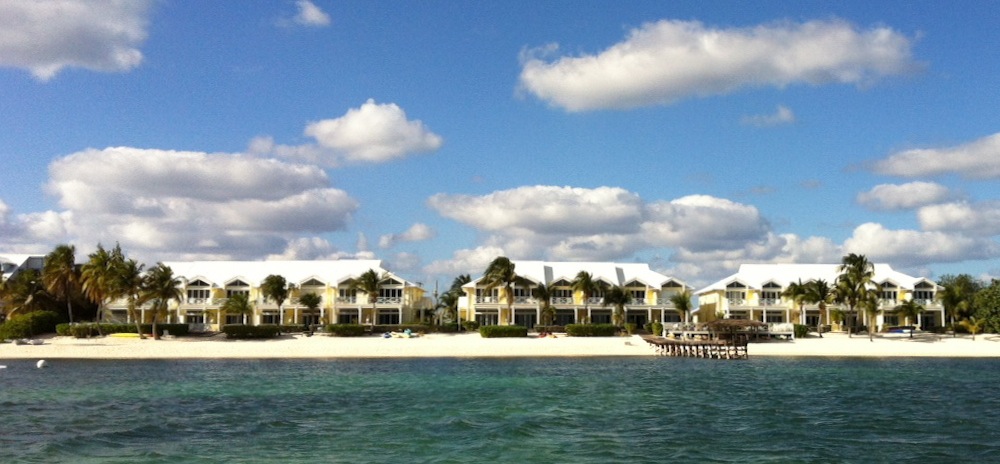
Existing oceanfront condominiums will be incorporated into Blacktip Island’s protective condominium wall.

Existing oceanfront condominiums will be incorporated into Blacktip Island’s protective condominium wall.

Blacktip business owners are spearheading plans to ring Blacktip Island’s coast in an unbroken wall of high-rise condominiums to safeguard against rising sea levels menacing the Caribbean island.

“Global warming’s on us, and we’re not prepared,” said Eagle Ray Cove resort owner Rich Skerritt, the plan’s chief backer. “This is the new face of life in the tropics: dual-purpose developments that’ll protect their islands while providing upscale coastal housing.

“Hell, 1,800 year ago the Chinese all laughed at Emperor Qin Shi and his wall. Now look at them.”

“It’s for the common good,” said Tiperon Islands Public Safety chief Ferris Skerritt, Rich Skerritt’s brother. “We’re all at risk from rising sea levels. Tourists are noticing and going to islands with higher elevation. We have to act now to protect our lives and our economy.”

Local scientists are skeptical of the plan.

“Blacktip’s only 10 feet above mean sea level, sure, and a minor rise in global sea levels would have us swimming,” Tiperon University-Blacktip’s Ernesto Mojarra said. “But I don’t know that ringing the coastline with multi-family dwellings will address that issue. The island’s a porous limestone. Rising water will just seep up through the ground.”

Environmentalists question the developers’ motives.

“Rich is using global warming as a Trojan horse so he can overdevelop the island,” Blacktip Haven resort owner Elena Havens said. “His condo wall will trap stagnant water inside and create a giant bowl of fetid goop. It’s bad enough we already have the booby pond.”

Other locals are concerned the project will negatively impact their quality of life.

“They can’t just block ocean access like that, no matter how high the water gets,” resident Ginger Bass said. “If we don’t own a fancy condo, how do we get to our boat? If we can’t get to the sea we can’t fish to feed our families.”

Rich Skerritt allayed those concerns.

“We’ll have drainage conduits to take the stinky water out,” Skerritt said. “And access tunnels so non-owners can get to the water to fish and whatnot. There’ll be a per-passage fee, of course, but that’s simply to defray the cost of the tunnels, not a fee for ocean access.”

Prospective condo owners, meanwhile, are eager to buy.

“They say all these buildings will be interconnected,” island visitor Suzy Souccup said. “When they’re finished, we’ll be able to walk all the way around the island without ever having to leave the air conditioning. What could be lovelier, and safer, than that?”

Leave a comment

Filed under Caribbean

Misprint Sparks Mayhem at Blacktip Island Poetry Slam

800px-Black-bellied_whistling_ducks_(Dendrocygna_autumnalis)

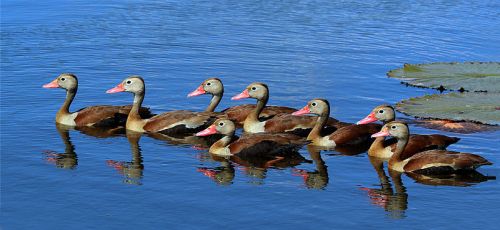
Blacktip Island Poetry Slam winner Reg Gurnard’s West Indian whistling ducks prepare to take the stage Thursday afternoon on the small Caribbean island. (photo by Charles J. Sharp)


Five Blacktip Island residents were hospitalized and an estimated 14 chickens and four ducks were injured Thursday after flyers for the Heritage Society’s annual Poetry Slam were incorrectly printed as “Poultry Slam.”

“We called the order in to the print shop, same as ever, and I clearly said ‘poetry,’” Heritage Society president Doris Blenny said. “Clete Horn read the text back to me, but he was slurring his words at the time and I guess we both misunderstood.

“The first sign of trouble was when twenty-plus people showed up at the Heritage House with poems in hand and birds under their arms,” Blenny said.

“The announcement said ‘poultry,’” island poet Alison Diesel said. “It seemed odd, but it is Blacktip Island, after all. I practiced for days – thawed Cornish hens, mostly – and wrote two sonnets set to the same beat. Rhyming with a live hen, though, in front of an audience, it’s harder than you’d think.”

Organizers proceeded with the event as advertised, but the performances were halted by animal rights protestors.

“It was crazy enough, with our local bards spouting verse and waving their chickens,” the Heritage Society’s Blenny said. “Then the PETA people stormed the stage and the feathers really flew.”

“Abusing birds so flagrantly, we had to cry foul,” local People for the Ethical Treatment of Animals president Harry Pickett said. “Sure, some of our folks got a bit out of hand, but really, thwacking chickens like that, those so-called artistes deserved a sock in the puss.”

Thirteen participants were charged with animal cruelty. Eight protestors were charged with battery. Several poets also were disqualified due to their over-reliance on duck-related rhyme schemes.

“This is a family event, after all,” Blenny said.

A handful of contestants dodged legal trouble by opting for figurative interpretations of the event’s theme.

“I slammed my Rhode Island Red rooster but good,” contestant Led Waite said. “Insulted him every which way, in rhyme royal, no less. I should’ve won some sort of prize.”

Other finalists substituted fried chicken and roast duck for living poultry. The winner used a gentler approach, with live birds.

“I trained each of my West Indian whistling ducks to quack a different note when I smacked them on the head,” Slam champion Reg Gurnard said. “It made for excellent counterpoint, me rapping and them quacking. And none of them the worse for wear.”

2 Comments

Filed under Caribbean

Experts To Identify Every Color of Blacktip Island’s Water

An international research team is set to determine the exact number of colors in the waters covering Blacktip Island’s reefs.

An international research team is set to determine the exact number of colors in the waters covering Blacktip Island’s reefs.

An international team of scientists and artists this week will test the seawater on Blacktip Island’s scuba dive sites to determine the precise number of blue shades the water contains.

“The question’s confounded scientists and scuba divers for decades,” Tiperon University-Blacktip hydrogeology professor Ernesto Mojarra said. “Is it the standard five-shade range we’ve heard about on dive boats, or is closer to the 17-shade scale our electron spectrophotometers seem to indicate?

“Our goal’s to catalogue every separate and distinct color here,” Mojarra said. “The next step’ll be to send our water samples to the Smithsonian for use as a baseline for any future water color cataloging worldwide.”

Island tourism workers and visitors embraced the news.

“We get tired of hearing it,” Eagle Ray Cove divemaster Gage Hoase said. “‘How many colors of reef water are there?’ and ‘Can we get a sample of each one?’ Now, hopefully, we can give our guests a solid answer and move on to the next stupid question.”

“All I want’s some little glass vials with different water colors in them,” island guest Candy Wrasse said. “The Eagle Ray Cove gift shop sells five-color gift sets. Sandy Bottoms’ has seven-color sets. Club Scuba Doo has eight. And Blacktip Haven sells swirly, blue-green sarongs they say have 113 colors. Some scientific clarity would be great.”

Other residents, however, were skeptical of the study’s goals.

“This isn’t a simple green, blue and indigo issue,” local activist Harry Pickett said. “The bigger picture is where are the lines drawn? Who draws them? And can the colors be gamed? Arbitrarily dividing seawater into someone’s preconceived notion of shading is really a statement on power and privilege.”

TU-B’s Mojarra was quick to defend the study.

“We have some of the world’s top colorimetrists, marine hydrologists and watercolor painters to triple-blind study our samples,” Mojarra said. “As for doctoring the water, it’s true, particulate matter can play a large part, but we’re running the water through a non-biased third party’s .01 micron filter to ensure minimal particle density.”

The island’s religious community remains unconvinced.

“All water is one. You can’t divide it into colors,” said the former-Reverend Jerrod Ephesians, head of the island’s ecumenical council. “Let the mystery be and enjoy your swim.”

Blacktip Island’s theosophists reacted more strongly.

“We wanted to do a group self-immolation at Diddley’s Landing Friday evening,” Palometa Fischer said. “But that gets so messy. Instead we’ll all sit cross-legged and throw water on ourselves. An anti-immolation, if you will, with each person using the water color of his or her choosing.”

Leave a comment

Filed under Caribbean, Scuba Diving

Blacktip Island Dive Sites Get Underwater Wi-Fi

Blacktip Island’s scuba diving guests can now roam the internet while underwater on the Caribbean island’s dive sites.

Blacktip Island’s scuba diving guests can now roam the internet while underwater on any of the Caribbean island’s dive sites.

Blacktip Island entrepreneurs Rich Skerritt and Sandy Bottoms have teamed up to install the first underwater wireless network for scuba diving guests on the small Caribbean island.

“It’s the 20-something generation of divers who’re behind it,’ Eagle Ray Cove resort owner Rich Skerritt said. “They get bored on safety stops. They want their social media. And if we don’t give it to them, you can bet the next guy will.”

“Underwater Wi-Fi draws divers to Blacktip Island, away from other dive destinations,” Sandy Bottoms’ Beach Resort owner Sandy Bottoms said. “It’s good for the island. A rising tide lifts all boats, you know.

“No one resort could foot the bill for something like this, so Rich and I threw in together to meet our guests’ needs,” Bottoms said.

The network functions via underwater routers hardwired to topside modems.

“We put antennas in all the dive site mooring balls, then ran cables down the mooring lines,” Blacktip Island Public Works head Stoney MacAdam said. “You can get a signal in a 50 foot radius of every mooring pin.

“Folks take a smart phone or a tablet down in a waterproof case and, voila, they’re streaming live video to their blogs and their kids are playing Candy Crush.”

The response among divers is split along generational lines.

“This is brilliant,” 28-year-old dive guest Kenny Chromis said. “Just looking at the reef is so 2014. I mean, what’s the point if you can’t share it in real time? Plus, we can leave the baby in the room and still monitor the crib-cam while we dive.”

Others are less enthusiastic.

“Leave it to the damn millennials to ruin diving, too,” said 53-year old scuba enthusiast Joe Pompano. “It used to be calming, a silent world. Now it’s all beeps and pings and yahoos Skyping through their regulators. Put the damn gadgets down and look at the fish, why don’t you.”

Blacktip’s dive operators have embraced the new technology.

“We’re selling waterproof tablet cases like crazy,” Club Scuba Doo dive operations manager Finn Kiick said. “Interactive fish ID apps, too.

“The hot spots also create an extra level of diver safety,” Kiick said. “Our Wi-Fi connected guests never stray more than 15 meters from the boat. And if one does wander off, we can track their signal from anywhere on the island.”

“This is the new frontier in scuba tourism,” Rich Skerritt said. “For a reasonable access fee, of course.”

Leave a comment

Filed under Caribbean, Scuba Diving

Mutant Crabs Protect Blacktip Island’s Reefs

Genetically-modified channel crabs, escapees from Cuban biological labs, are now protecting Blacktip Island’s marine parks.

Genetically-modified channel crabs, escapees from Cuban biological labs, are now protecting Blacktip Island’s marine parks.

The Tiperon Island Marine Parks Department Friday confirmed reports it is using laboratory-bred channel crabs to protect Blacktip Island’s dive sites against scuba diver-related damage, tasking the crustaceans with pinching divers who come in contact with the Caribbean island’s fragile reefs.

The crabs, larger and more aggressive than wild channel crabs, are a byproduct of the genetic research of famed Cuban geneticist Pellizco de Cangrejo, Tiperon University-Blacktip biology professor Ernesto Mojarra said.

“It’s a gene-splicing experiment gone horribly wrong,” Mojarra said. “Instead of big, tasty crabs, they ended up with big, mean ones. Then the crabs broke out of the lab and took over the reefs. For a short time they controlled significant portions of Old Havana.

“Trade winds and currents carried some of them to Blacktip Island’s reefs, where they’ve become intractable.”

“These suckers are nasty,” said marine parks spokesperson Val Schrader said. “They’ll defend their territory to the death. We’re lucky we’ve been able to recruit them to our side.

“Scuba tourism’s our life’s blood, but reef-crashing divers are fast destroying that,” Schrader said. “We have to take action. One touch from a careless diver can kill an entire coral head. We’re strapped for cash, or we’d hire more officers. With these crabs onboard, well, it’s win-win. The reefs are safe, and we don’t have to pay wages or benefits.”

Local reaction to the news has been positive.

“We’ve had the crabs for years,” Club Scuba Doo dive operations manager Finn Kiick said. “They’re more of a nuisance than anything. We can’t get rid of them, so we might as well embrace them.”

“Recreational divers have to learn: you touch coral, you pay the price,” Blacktip Haven owner Elena Havens said. “You think a stingray hickey’s bad? Wait ‘til you get a Cuban crab pinch.”

Scuba diving visitors, however, are furious.

“These monsters have been leaving us bruised and bloody for years,” longtime Blacktip Island dive guest Buddy Brunnez said. “Now, to find the government’s sponsored it? It’s like a bad horror movie. Trip Advisor’s getting some scathing reviews about this. We pay good money to dive here. We can touch anything we want.”

Meanwhile, island dive shops are making the most of the situation.

“We’re selling Peak Performance Buoyancy courses like hotcakes,” Eagle Ray Divers operations manager Ger Latner said. “It’s amazing how motivating a 450 foot-pound pinch in the shorts can be. Our Crab Diving specialty courses are jam packed, too.”

Marine Parks officials would not confirm rumors of other marine life being trained to safeguard the island’s reefs.

“Moray eels chomp divers all the time,” Schrader said. “And it’s not uncommon for pike blennies to take a chunk of flesh from a diver who strays too close. That’s just coincidence. Reef life protecting itself.”

Leave a comment

Filed under Caribbean, Scuba Diving