
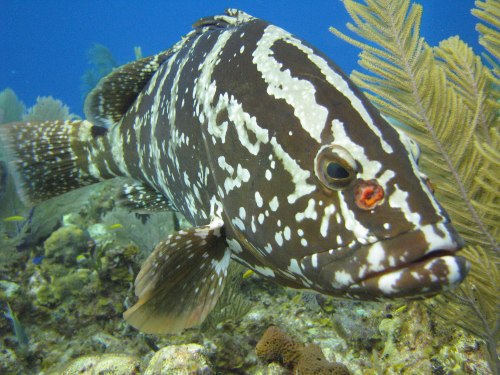
Aggregations of usually-docile Nassau groupers began attacking fishing boats around Blacktip Island this week. (photo courtesy of Oregon State University)
Schools of Nassau groupers this week began what authorities are calling a series of coordinated attacks on boat rudders and propellers around Blacktip Island for unknown reasons.
“All of a sudden there’s been a spate of these group attacks, all by Nassau groupers, a species not known for schooling,” marine parks spokesperson Val Schrader said. “They’re going after boat rudders and propellers, and only stop their attacks when the boat is disabled.
“There’s reports of whales doing this sort of thing to sailboats in the Mediterranean, but never with grouper in the Caribbean,” Schrader said. “Why they’re doing this, and why now, is still a mystery. Our leading theory is a fisherman angered a grouper, and the fish is getting revenge by teaching others to join it in attacking boats in unison.”
Scientists suspect a less-vindictive cause.
“Nassaus getting together to attack is pretty far-fetched,” Tiperon University-Blacktip marine biology professor Ernesto Mojarra said. “But they’re quite intelligent, and playful. Our hypothesis is the fish have simply invented a new game and are oblivious to the damage they’re causing.
“There’s also the possibility this is a transient group passing through the region,” Mojarra said. “That ould explain the sudden occurrence and the new behavior. We’re doing studies into both scenarios.”
Local fishermen, bearing the brunt of the attacks, are taking steps to safeguard their boats.
“Grouper come after me, they gonna get a oar to the head,” Harry Blenny said. “Safe enough when the propeller’s spinning, but soon as I turn the motor off and start fishing, them grouper come at me. Getting revenge on fishermen’s what’s behind it. Need to catch the ringleader, teach the others a lesson.”
Scuba operators have been less affected.
“Our boats have pretty big rudders, so a Nassau’d have a tough time damaging it,” Eagle Ray Divers ops manager Ger Latner said. “We’re also on their side, telling our divers to protect the reef and to not harass marine life. That may have something to do with it as well. None of us have killed their fishy friends.”
Other experts posited a more esoteric motivation.
“The simplest explanation is they just don’t want to be called ‘grouper’ anymore,” fish psychologist Jodi Hamlet said. “These are solitary fish, each with its own personality, and they’ve not only been lumped together, they’ve been given the quintessential generic ‘group’ name. And now they’re stuck with it.
“These attacks are simply their way of reclaiming the name, acting as a group to make the term their own,” Hamlet said. “They’re sliding that signifier under a new signifier, making these individual ‘grouper’ acts the new signified. They’ve remade themselves. And I think we need to respect that.”




 The Blacktip Times